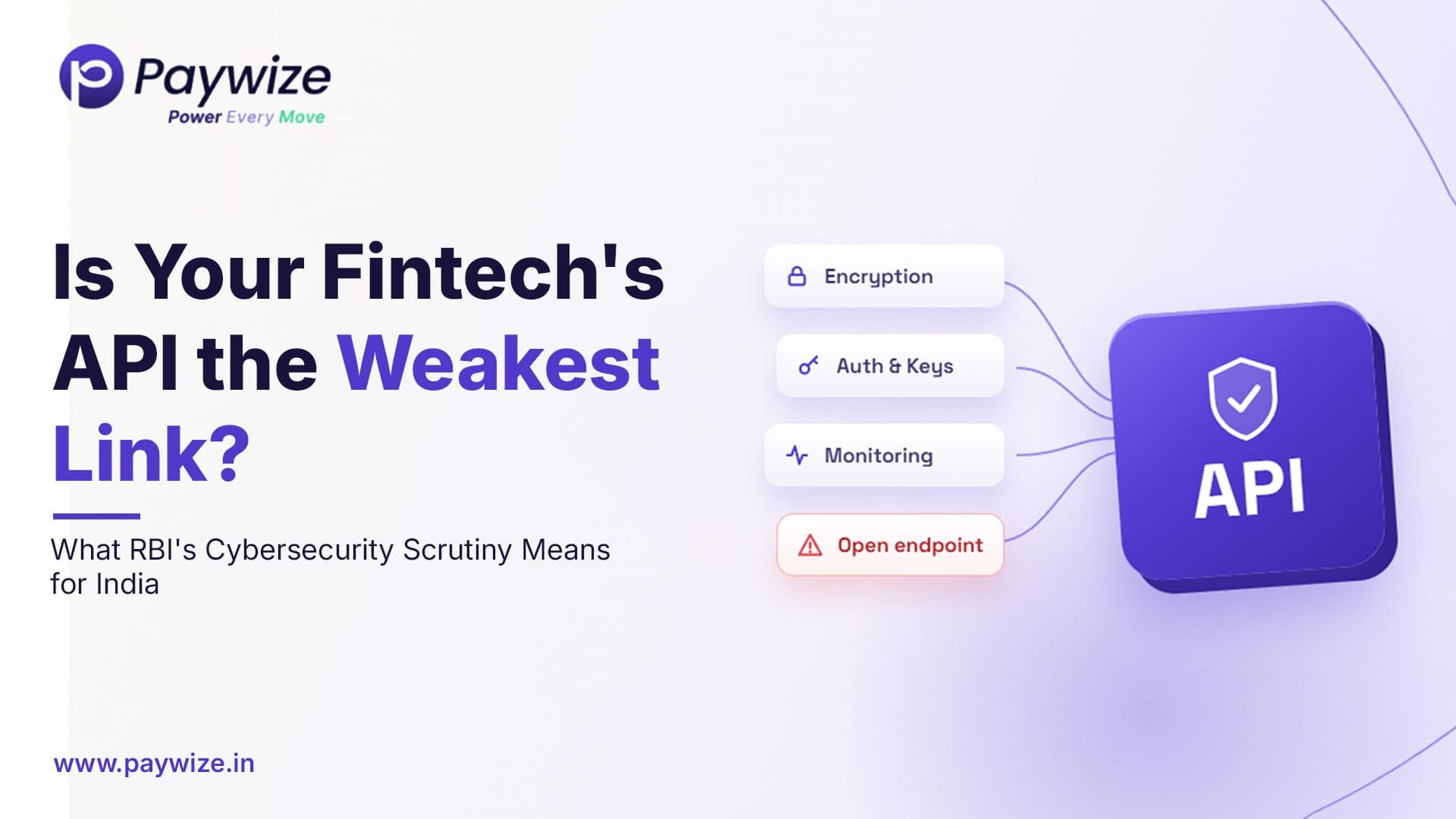
Is Your Fintech's API the Weakest Link? What RBI's Cybersecurity Scrutiny Means for India
An API can be encrypted, authenticated and available around the clock. But can it tell whether a payment instruction should have been issued in the first place?
JJ
Jagriti Jaiswal
Head of Marketing
An API can be encrypted, authenticated and available around the clock. But can it tell whether a payment instruction should have been issued in the first place?
That distinction is becoming increasingly important for India's banking and fintech ecosystem.
For years, financial institutions have used APIs to connect banking systems, lending platforms, payment infrastructure and third-party technology providers. These integrations have made financial services faster and more accessible. They've also created a difficult security question: when a trusted system sends an instruction, how does the receiving institution know that the instruction is legitimate?
Recent events have brought that question into sharp focus.
On October 30, 2026, Reuters reported that the Reserve Bank of India (RBI) was intensifying its scrutiny of cybersecurity preparedness at banks. According to people familiar with the discussions, the regulator had asked lenders to examine vulnerabilities in application programming interfaces (APIs), demonstrate compliance with existing requirements and explain their readiness for AI-related threats.
The concern wasn't limited to the banks themselves. Smaller lenders, NBFCs and third-party technology providers were also attracting attention as potential entry points into interconnected financial systems.
For India's fintech industry, the message is significant: securing an API connection is not necessarily the same as securing the financial instruction passing through it.
The cyberattack that changed the conversation
Consider what happened in October 2026.
According to a police complaint reviewed by Reuters, two Mumbai-based non-banking lenders suffered losses of approximately $2 million after more than 700 unauthorized instant transfers were made on October 8–9.
The complaint alleged that attackers compromised an API connection used to send loan-disbursement instructions to ICICI Bank.
That detail matters.
The reported incident was not simply about a website going offline or a database being exposed. It involved a technology connection through which instructions could lead to actual movement of funds.
The precise technical mechanism has not been publicly established in the reporting reviewed for this article. We therefore cannot conclude whether the attackers exploited stolen credentials, inadequate authorization controls, a compromised application or some combination of weaknesses.
But the incident illustrates a broader architectural risk.
When a system is trusted to issue financial instructions, compromising that system—or its authority to issue those instructions—can have consequences beyond the system itself.
Source: Reuters, October 30, 2026.
Why an authenticated API request may still be dangerous
An API is a mechanism that allows two software systems to communicate.
In financial services, an API might allow an authorized application to request account information, initiate a supported banking workflow, submit a disbursement instruction or retrieve a transaction status.
Security controls commonly help answer questions such as:
Is the connection encrypted?
Is the application presenting valid credentials?
Does the caller have permission to access this API?
Is the request formatted correctly?
These checks are essential. But they don't always answer a separate question:
Is this particular transaction consistent with what the business actually intended to do?
Imagine a lending platform authorized to initiate loan disbursements through a banking integration.
Its API credentials are valid. Its connection is encrypted. The bank recognizes the platform as an approved caller.
Now imagine that an attacker gains control of an authorized component and submits a disbursement instruction that the business never approved.
Depending on the controls in place, the request may satisfy technical authentication checks even though the underlying instruction is unauthorized.
This is a hypothetical scenario, not a reconstruction of the October incident.
It illustrates why financial API security needs to consider both the identity of the caller and the legitimacy of the requested action.
Authentication establishes who or what is calling. Authorization establishes what that caller is permitted to do. Transaction-level business controls help determine whether a particular instruction should proceed under the institution's rules.
These are related protections, but they are not interchangeable.
The hidden gap: A secure connection can carry an unauthorized instruction
This is where the discussion becomes more important than the familiar advice to encrypt traffic and protect API keys.
A financial instruction passes through several decisions before money moves.
For example, a legitimate disbursement may need to correspond to an approved loan, an authorized beneficiary, an expected amount and a valid business event.
An API gateway may confirm that a request comes from an authorized system. Yet the wider transaction workflow must still establish whether those business conditions have been met.
A useful way to think about the distinction is:
Security question
What it establishes
Is the API connection protected?
Whether information is protected in transit
Is the caller authenticated?
Whether the system can identify the caller
Is the caller authorized?
Whether the caller has permission for the requested operation
Is the transaction legitimate?
Whether the instruction meets the institution's business and risk controls
Can the transaction be investigated?
Whether records allow the instruction and its approval history to be reconstructed
The last two questions deserve more attention in conversations about banking API security.
A transaction can be technically well-formed without being commercially legitimate. And an institution may have extensive application logs without having a clear record of who approved the underlying financial action.
That leads to an important conclusion:
The security boundary of a financial API should extend beyond the endpoint to the business decision that authorizes the transaction.
This is an architectural recommendation, not a claim that RBI has prescribed one universal transaction-authorization design for every API.
What RBI's increased scrutiny actually means
There is an important distinction between a new regulation and stricter supervision of existing requirements.
The October 30 Reuters report describes RBI asking banks to demonstrate compliance with cybersecurity rules already in place, examine API weaknesses and assess emerging risks, including AI-related threats.
It should not be interpreted as proof that RBI introduced a completely new API-security law on October 30.
India's regulated financial institutions already operate under technology-risk, cybersecurity and outsourcing requirements. The applicable obligations depend on the type of regulated entity and the relevant directions.
For example, RBI's 2023 Directions on Outsourcing of Information Technology Services establish that outsourcing does not remove a regulated entity's responsibility for its obligations. They also address risk assessment, service-provider oversight, information security, incident reporting and continuity planning.
In July 2026, RBI also issued consolidated cybersecurity and technology-risk directions for different categories of regulated financial institutions, including NBFCs. These directions must be read according to their stated applicability.
The broader implication is that institutions cannot treat technology-provider security as a matter that ends when a contract is signed.
They need appropriate visibility into the risks associated with the technology arrangements on which their operations depend.
A question every bank–fintech partnership should be able to answer
If an unauthorized payment instruction entered your system today, could you reconstruct its journey from business approval to banking execution?
Not merely the HTTP request.
The entire journey.
Which application originated the instruction? Which business event triggered it? What authorization was required? Was the beneficiary expected? Were any limits exceeded? What response came back? Could the instruction have been duplicated? Which records would help investigators understand what happened?
These questions bring together cybersecurity, financial operations and technology governance.
They also expose why a successful API response is not, by itself, evidence that a transaction was properly authorized.
A response such as 200 OK generally indicates that an HTTP request was successfully handled at the protocol level. It does not automatically establish that a financial transaction was approved, settled or legitimate.
Likewise, a payment status update should be interpreted according to the specific API's documented semantics rather than assumed to represent final settlement.
For institutions operating at scale, those distinctions matter during ordinary reconciliation as well as during security investigations.
Five controls worth examining in financial API workflows
No single checklist can eliminate cyber risk. The following are practical areas that banks, fintechs and technology providers can assess based on their responsibilities and architecture.
1. Separate API access from transaction authority
Access to an API should not automatically imply unrestricted permission to initiate every available financial operation.
Organizations can consider granular permissions, transaction limits, beneficiary restrictions and approval rules appropriate to the business use case.
For sensitive operations, the application should establish the business authority behind the instruction, not simply the identity of the connected system.
2. Treat credentials as a potential point of compromise
API keys, tokens and other credentials are valuable targets because they may allow attackers to impersonate legitimate applications.
Organizations should review credential storage, access restrictions, rotation procedures, revocation mechanisms and the use of short-lived credentials where appropriate.
Credential management also needs a practical emergency procedure. If an integration is suspected of compromise, the institution should know how access can be suspended without unnecessarily disrupting unrelated services.
3. Monitor unusual transaction behavior
A legitimate integration may suddenly exhibit unusual activity.
Examples include unexpected increases in transaction frequency, unfamiliar beneficiaries, abnormal transaction amounts or activity outside established operating patterns.
These signals do not prove fraud. But they can justify additional verification or investigation.
The appropriate monitoring approach depends on the product, customer behavior, risk appetite and regulatory obligations.
4. Preserve a usable transaction audit trail
A strong audit trail should help investigators connect the business event, authorization decision, API instruction and resulting transaction status.
Where appropriate, records can include timestamps, unique identifiers, relevant approval references, system identities and changes to transaction state.
Sensitive credentials and unnecessary personal information should not be written into logs.
The goal is not to collect as much data as possible. It is to preserve reliable evidence that can answer meaningful operational and security questions.
5. Test what happens when an integration fails or is compromised
Security planning often focuses on preventing unauthorized access.
Equally important is understanding what happens when prevention fails.
Can an affected integration be isolated? Can suspicious instructions be paused where the workflow supports it? Who contacts the banking partner? What evidence is available? How are customers and regulators notified when required?
These are business-continuity questions as much as cybersecurity questions.
A bank may operate a mature security program while relying on external applications and technology providers for particular workflows.
That creates a shared operating environment, but not necessarily shared regulatory accountability.
RBI's 2023 IT Outsourcing Directions place responsibility on regulated entities to oversee relevant outsourced arrangements. The directions also address risks involving multiple service providers and the need to understand their control environments.
This matters because a financial transaction may depend on more than one organization.
A merchant or lender may use a technology platform, which communicates with a banking partner through an API, while other systems manage approvals, notifications and reconciliation.
Each additional integration introduces dependencies that need to be understood.
The question is not whether third-party technology should be avoided. Such technology is central to modern financial services.
The question is whether the organizations involved have clearly defined responsibilities, appropriate controls and sufficient visibility when something goes wrong.
What AI changes—and what it doesn't
AI-assisted cyberattacks are part of the current regulatory discussion.
Reuters reported that CERT-In had warned about attackers stealing banking API credentials and potentially using AI-assisted tools. The report also described RBI's interest in how banks are preparing for AI-related risks.
However, the public reporting reviewed here does not establish that AI was used in the October 8–9 unauthorized-transfer incident.
That distinction matters.
It would be misleading to present every recent API compromise as an AI-powered attack.
AI may increase the speed or sophistication of certain malicious activities, but familiar security weaknesses remain important: compromised credentials, excessive permissions, inadequate monitoring and insufficient separation between technical access and business authorization.
The practical response is not to attach the label “AI security” to every control.
It is to understand how threats are changing while strengthening the underlying safeguards that protect financial instructions.
Where payment infrastructure fits into this discussion
For businesses, cybersecurity and payment operations are often treated as separate concerns.
Security teams focus on access, vulnerabilities and incident response. Finance teams focus on collections, payouts, reconciliation and transaction status. Engineering teams focus on integration reliability.
But a transaction crosses all three functions.
When an unexpected instruction appears, technical logs may show how it entered a system. Operational records may show whether it matched an approved business event. Reconciliation records may help establish the financial outcome.
These records serve different purposes, and no single dashboard replaces a complete security program.
At Paywize, our work in API-driven payment infrastructure and banking integrations reinforces the importance of connecting technology workflows with transaction visibility and operational clarity.
Paywize operates as a technology service provider, integrating with licensed banking and payment partners. Regulated financial services are provided by the relevant licensed entities.
For businesses evaluating payment infrastructure, useful questions include how transaction statuses are communicated, how workflows are tracked, what reconciliation information is available and how integration responsibilities are defined.
These are not substitutes for cybersecurity controls. They are part of building payment operations that can be understood, monitored and investigated when necessary.
The next question for India's fintech ecosystem
India's financial technology ecosystem has spent years making transactions easier to initiate.
The next challenge is ensuring that the systems initiating those transactions remain accountable, observable and resilient.
An encrypted API is important. Strong authentication is essential. Reliable monitoring matters.
But none of these should be mistaken for complete proof that a particular financial instruction was legitimate.
The October 2026 cyber incidents are a reminder that trust between connected systems needs to be supported by controls, not simply assumed because an integration has been approved.
For banks, NBFCs and fintech technology partners, that may be the most useful question to take away from RBI's increased scrutiny:
When a trusted API asks to move money, what independently establishes that the instruction deserves to be trusted?
Frequently Asked Questions
What is RBI's latest concern about fintech API security in 2026?
According to Reuters reporting from October 30, 2026, RBI has intensified its scrutiny of banks' cybersecurity preparedness, including API vulnerabilities, compliance with existing requirements and readiness for AI-related threats. The reporting describes supervisory attention rather than a new universal API-security regulation introduced on that date.
Can an API be secure and still process an unauthorized transaction?
Yes. Encryption and authentication protect important aspects of an API connection, but they do not necessarily establish the legitimacy of every business instruction. A compromised authorized application, for example, may be able to submit requests that pass technical access checks unless additional controls prevent them.
Are fintech technology providers directly regulated by RBI?
Not necessarily. Regulatory status depends on the entity's activities, authorizations and applicable law. A technology service provider is not automatically an RBI-regulated bank or payment aggregator. However, regulated institutions may have obligations to assess and oversee relevant outsourced technology arrangements.
What is third-party risk in banking APIs?
Third-party risk is the possibility that a service provider, connected application or other external dependency introduces security, operational, data-protection or continuity risks into a regulated institution's operations.
What is the difference between API authentication and transaction authorization?
API authentication verifies the identity of a caller. Authorization determines what actions that caller may perform. Transaction-level controls can additionally verify whether a specific financial instruction satisfies applicable business rules and approvals.
Does RBI require every fintech to follow the same cybersecurity framework?
No. Requirements depend on the entity's regulatory classification, activities and the applicability provisions of the relevant RBI directions. Banks, NBFCs and other regulated entities should consult the directions applicable to them. Technology providers should also understand relevant contractual and legal obligations.
How can financial institutions reduce API-related payment risks?
Relevant measures may include strong credential management, granular permissions, transaction-level approvals, anomaly monitoring, secure audit trails, incident-response procedures and appropriate oversight of technology providers. Controls should be selected according to the institution's risks and applicable obligations.
Editorial note: This article is based on publicly reported incidents and published regulatory materials available as of November 3, 2026. Hypothetical examples and recommended controls are explanatory analysis, not findings from an incident investigation or a substitute for legal and cybersecurity advice.
For information & enquiries: Jagriti Jaiswal Head of Marketing marketing@paywize.in Paywize Technologies Pvt. Ltd.
Share:
READY TO GET STARTED?
Join 1,200+ merchants using Paywize to power their payment infrastructure.