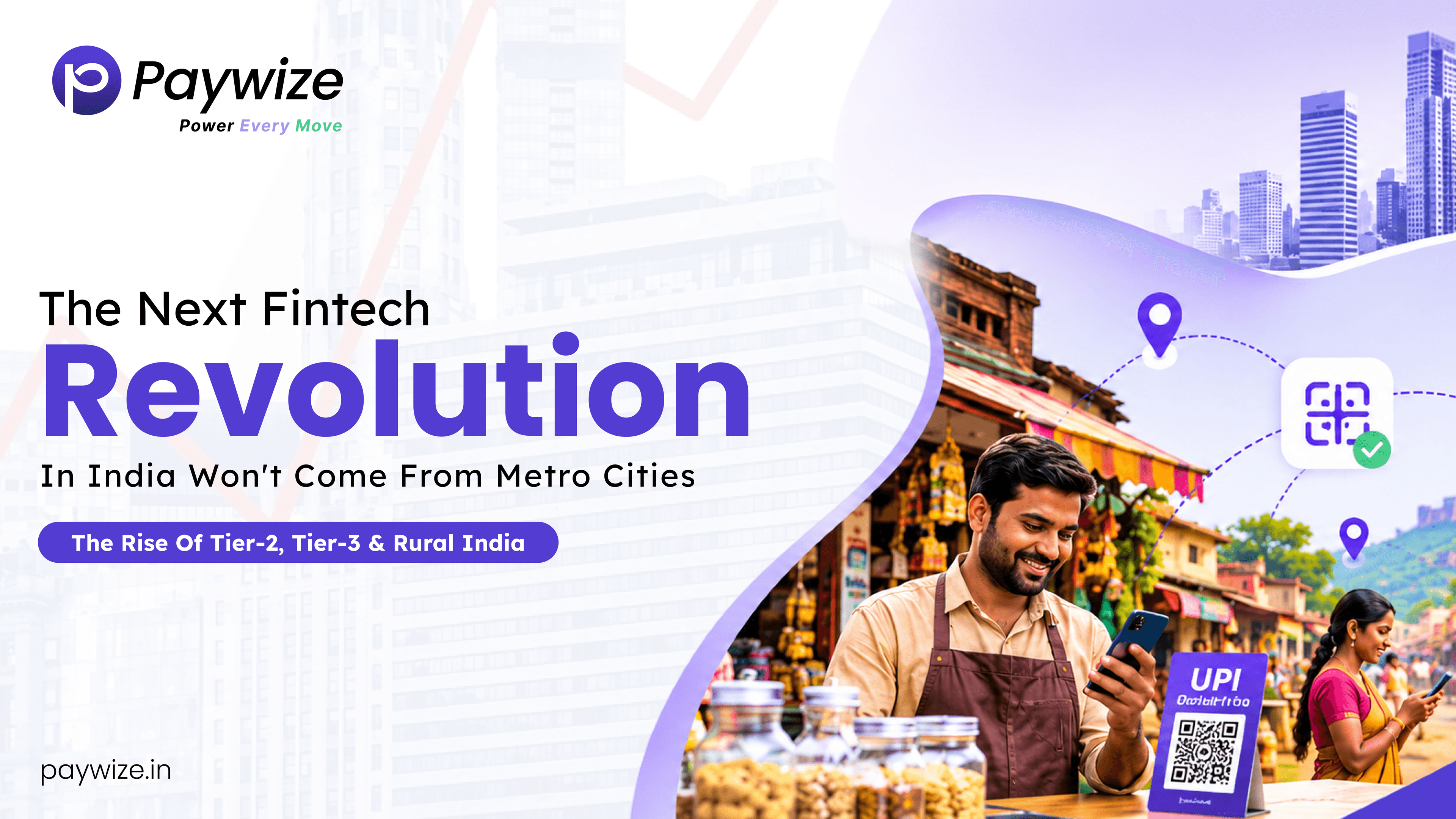
The Next Fintech Revolution in India Won't Come From Metro Cities
Why Tier-2, Tier-3, and rural India could define the next chapter of digital payments, and why accepting money is only half the story.
JJ
Jagriti Jaiswal
Head of Marketing · 16 November 2026
Why Tier-2, Tier-3, and rural India could define the next chapter of digital payments, and why accepting money is only half the story.
For years, India's fintech story has been told through its biggest cities. Bengaluru built the startups, Mumbai brought the financial institutions, and Delhi NCR attracted investors, founders and technology talent.
But beyond these familiar centres, another financial ecosystem is taking shape.
A wholesale distributor in a smaller industrial town supplies goods to dozens of retailers. A school collects fees from hundreds of families. A diagnostic centre receives payments from patients, insurers and corporate clients. A logistics operator coordinates deliveries, collections and settlements across multiple locations.
These businesses may not resemble the typical fintech startup customer. They may not have large engineering teams, sophisticated finance software or dedicated payment-operations departments. Yet they handle significant business transactions every day, and increasingly, those transactions are digital.
The opportunity is no longer simply to introduce these businesses to digital payments. It's to make digital payments work for the way they actually do business.
That could become one of India's most important fintech opportunities over the coming decade.
1. India's Digital Economy Is Already Moving Beyond the Metros
The numbers make it difficult to dismiss smaller markets as a future opportunity.
According to the IAMAI–Kantar Internet in India Report 2025, India had approximately 958 million active internet users in 2025. Rural India accounted for around 548 million users, representing more than 57% of the total. The report also found that rural internet adoption was growing at nearly four times the pace of urban adoption.
Telecom data reinforces this direction. TRAI's 2025–26 performance report recorded 440.87 million rural internet subscriptions as of March 31, 2026, compared with 407.69 million a year earlier.
Although IAMAI–Kantar measures active internet users and TRAI measures internet subscriptions, both datasets demonstrate the growing scale of digital connectivity outside India's major cities.
UPI adoption provides another important perspective. According to NPCI, UPI processed approximately 25.47 billion transactions worth ₹31.53 lakh crore in October 2026. These are national figures, not rural-only statistics, but they illustrate the scale of India's digital payment ecosystem.
Together, these developments raise an important question: Is India's financial infrastructure evolving quickly enough to support the businesses participating in this expanding digital economy?
2. The QR Code Solved One Problem. It Didn't Solve the Entire Business.
Consider a familiar situation.
A customer visits a neighbourhood store, purchases goods and scans the merchant's UPI QR code. The payment is completed within seconds.
For the customer, the transaction is over. For the merchant, however, the payment may be only one part of a larger process.
The business may still need to identify the corresponding invoice, update its accounting records, track partial payments and reconcile daily collections against sales.
For a small retailer handling limited transactions, these activities may be manageable manually. But for a distributor serving hundreds of retailers, an educational institution collecting fees or a healthcare provider receiving payments from different sources, the operational complexity can increase considerably.
This highlights a distinction often overlooked in discussions about India's digital payment success:
Payment acceptance is not the same as payment management.
UPI has made receiving digital payments easier. However, a successful transaction does not automatically tell a business which invoice was paid, whether an outstanding amount has been fully settled or how the payment should be recorded.
That requires structured information, operational processes and, in many cases, additional technology.
3. The Real Fintech Gap May Be Operational, Not Transactional
Financial inclusion is often discussed in terms of access. Can someone open a bank account? Can they make a digital payment? Can a merchant accept UPI?
These remain important questions, particularly in markets where connectivity, accessibility and financial literacy continue to present challenges.
But for businesses already accepting digital payments, a different set of problems is emerging.
Consider some common operational situations:
B2B distributors: Payments arrive without clear invoice references, making it difficult to identify which customer has settled which amount.
Educational institutions: Fee payments need to be matched with individual students, academic periods and outstanding balances.
Healthcare providers: Collections from different sources need to be associated with the correct bill or patient account.
Logistics businesses: Payments must be connected to individual deliveries, shipments or collection agents.
Housing societies: Maintenance payments and other contributions require member-level identification and reconciliation.
These challenges do not necessarily indicate a failure of UPI. They reflect the additional work required to convert a successful payment into an accurate business record.
For a growing merchant, the question is no longer simply, "Can I collect money digitally?"
It becomes:
"Can I identify, track and reconcile every collection without manually rebuilding my financial records?"
That is where a new category of fintech opportunity begins.
4. The Overlooked Opportunity: Smaller Businesses Don't Necessarily Need Another Payment App
Much of India's fintech innovation has focused on making payments easier to initiate through faster checkouts, better interfaces and additional payment options.
These improvements matter. But they don't address every merchant's operational challenges.
Imagine a wholesale distributor in a Tier-3 town supplying inventory to 150 retailers. Some customers pay immediately, others settle invoices in instalments, and several transfer money without mentioning an invoice number. Meanwhile, sales representatives collect payments from customers in the field.
At the end of the week, the distributor needs to establish which retailers have paid, which invoices remain partially outstanding and which collections require investigation.
Would another consumer payment application solve this problem?
Probably not.
What the distributor needs is a system that connects incoming payments with the underlying business transactions. Depending on the workflow, that might involve invoice-linked collection references, transaction notifications, reconciliation tools and integration with existing accounting software.
This is an illustrative scenario rather than a measured description of all Tier-3 distributors. Nevertheless, it highlights an important opportunity.
The next meaningful fintech innovation for many smaller businesses may not be a better payment button. It may be the technology that eliminates unnecessary work after the payment is made.
5. Five Business Segments Where the Opportunity Is Particularly Relevant
Not every business outside a metro city is underserved, and not every merchant requires sophisticated payment infrastructure.
The opportunity becomes clearer when examined through specific industries and their operational requirements.
5.1 B2B Distribution and Wholesale: Making Every Collection Accountable
Wholesale businesses often operate through repeat orders, established customer relationships, credit arrangements and multiple payment methods.
A single retailer may have several outstanding invoices, while one payment may cover multiple orders or only part of an outstanding balance.
For distributors managing growing customer networks, structured collection references and reconciliation processes can help reduce manual investigation and improve visibility over receivables.
The opportunity is not simply accepting digital payments. It is connecting those payments to invoices and customer accounts.
5.2 Education: Connecting Fee Payments With Student Records
Schools, colleges and educational institutions collect tuition fees, transport charges, admission fees and other payments from hundreds or thousands of families.
Even when parents pay digitally, institutions still need to identify the student, fee category, academic period and outstanding amount.
Payment workflows linked to student or fee references can make these records easier to manage, particularly for institutions operating across multiple campuses or centres.
5.3 Healthcare: Bringing Clarity to Multiple Payment Sources
Hospitals, diagnostic centres and healthcare networks may receive payments from patients, corporate clients and other authorized sources.
Different departments may also maintain separate billing and operational records.
The challenge is ensuring that each collection can be associated with the appropriate bill, patient account or service.
Clear transaction information and reconciliation processes can support finance teams while allowing healthcare professionals to focus on patient care.
5.4 Logistics and Distribution Networks: Connecting Payments to Deliveries
Logistics businesses may handle payments associated with multiple customers, deliveries, riders and branches.
In cash-on-delivery operations, digital collections and cash handling may coexist, creating additional reconciliation requirements.
Linking payment information to shipment or delivery references can help businesses identify completed collections, outstanding amounts and discrepancies more efficiently.
5.5 Housing Societies and Community Institutions: Simplifying Repeated Collections
Housing societies and community institutions collect maintenance charges, service fees and other contributions from multiple members.
When payments arrive without clear references, finance teams may need to identify and match them manually.
Structured collection information and clear transaction records can help make these processes more manageable.
Across all five segments, the common challenge is not necessarily a lack of digital payment acceptance. It is the operational effort required to manage those payments effectively.
6. Why Metro-Centric Fintech Models May Not Work Everywhere
A payment product designed for a large technology company may assume access to developers, dedicated finance teams and sophisticated business software.
A smaller business may operate differently.
Its accounting process may depend on spreadsheets or local software providers. Employees may handle multiple responsibilities. Connectivity and device availability may vary, while customers may prefer regional languages or assisted digital experiences.
The IAMAI–Kantar 2025 report highlights the importance of shared-device access, finding that nearly 80% of users accessing the internet through someone else's mobile device were located in rural areas.
This does not suggest that rural users are less capable of adopting technology. Rather, it highlights the importance of designing products around different usage environments.
For fintech providers, six practical considerations deserve attention:
Ease of adoption: Can businesses use the solution without extensive technical expertise?
Workflow compatibility: Does the product fit existing accounting and operational processes?
Transaction visibility: Can staff easily understand payment statuses and exceptions?
Accessibility: Does the experience account for language, connectivity and device requirements?
Operational efficiency: Can businesses reduce repetitive payment-related administrative work?
Commercial suitability: Is the pricing understandable and appropriate for the merchant's transaction patterns?
The most successful solution may not be the one offering the greatest number of features. It may be the one that fits naturally into how the business already operates.
7. India's Next Fintech Opportunity Needs More Than UPI Adoption
India has already established one of the world's most significant digital payment ecosystems.
According to RBI's Payment System Report, December 2025, UPI accounted for 85.5% of payment transaction volume during the second half of calendar year 2025, across the payment systems covered in the report.
This demonstrates the scale and importance of UPI as a payment rail.
However, the success of a national payment system and the operational readiness of an individual merchant are different things.
A business may have access to digital payments yet still struggle with transaction identification, accounting records, partial collections and reconciliation.
The next stage of fintech innovation should therefore consider business outcomes beyond payment acceptance.
Important questions include:
How easily can businesses connect incoming payments to invoices and customer accounts?
How much manual effort is required to reconcile transactions?
Can finance teams understand payment statuses without switching between multiple systems?
Can businesses manage collections and payouts as transaction volumes increase?
Can existing payment infrastructure integrate with the tools merchants already use?
These questions bring the conversation closer to the everyday realities of merchants.
They also highlight the opportunity for payment infrastructure providers to support the processes surrounding transactions, rather than focusing exclusively on payment initiation.
8. Where Paywize Fits Into India's Next Fintech Growth Story
For businesses expanding beyond India's major metros, payment infrastructure should support growth rather than introduce additional operational complexity.
A distributor should be able to focus on fulfilling orders. An educational institution should be able to focus on its students. A healthcare provider should be able to focus on patient services.
Their payment workflows should support these activities.
At Paywize, we approach this challenge through API-driven payment infrastructure and banking integrations designed to connect payment-related processes with business operations.
Our core focus areas include:
UPI Collections: Supporting businesses with digital collection workflows, transaction information and relevant integration capabilities.
Payouts: Enabling supported business payout workflows through integrations with licensed partners.
Connected Banking: Helping businesses connect supported banking functions with their operational systems through APIs.
Paywize operates as a Technology Service Provider (TSP). Relevant payment and banking services are powered through licensed partners, and Paywize does not hold customer funds.
For businesses in Tier-2, Tier-3 and smaller markets, the opportunity is to build more connected payment workflows that support collections, payouts, transaction visibility and reconciliation.
However, not every merchant requires a complex API integration, and not every business faces the same operational challenges.
The starting point should always be understanding the business workflow and identifying the technology that best supports it.
9. What the Next Wave of Fintech Innovation Should Prioritize
If fintech innovation is to create meaningful value for businesses beyond India's metros, three priorities deserve attention.
Priority 1: Build Around Business Use Cases
A school collecting fees and a wholesaler collecting invoice payments may both use UPI, but their reconciliation requirements are fundamentally different.
Fintech products should address these industry-specific needs rather than treating every merchant as part of one generic category.
Priority 2: Make Existing Payment Infrastructure Easier to Use
India has already invested in powerful digital payment systems.
The opportunity now is to connect those systems more effectively with the software and workflows businesses depend on.
That includes appropriate integration options, clear transaction references, operational visibility and dependable support.
Priority 3: Measure Success Through Business Outcomes
Transaction growth remains an important indicator, but it should not be the only measure of success.
Businesses also need to understand what they have collected, what remains outstanding and which transactions require attention.
Reducing this uncertainty can create meaningful operational value even when the underlying payment method remains unchanged.
10. The Next Fintech Revolution May Be Quieter Than the Last
India's first major digital payment transformation was easy to recognize.
QR codes appeared at neighbourhood stores. Mobile payments became part of everyday commerce. Customers became accustomed to transferring money in seconds.
The next transformation may be less visible, but equally meaningful.
It could happen when a distributor no longer spends hours matching bank credits to invoices, when a school can identify fee payments without manually searching transaction records, or when a logistics business can connect collections to individual deliveries with greater clarity.
These improvements may not attract the same headlines as the rise of UPI, but they can make a significant difference to how businesses operate.
Metro cities will continue to be important centres of fintech innovation. The next phase will not exclude them.
Yet the opportunity to serve businesses in Tier-2, Tier-3 and rural markets is substantial, and their requirements should increasingly influence what gets built.
India has already made extraordinary progress in helping people move money digitally. The next fintech opportunity is helping businesses make sense of that money.
And that revolution won't need a metro-city address.
Frequently Asked Questions
1. Why are Tier-2 and Tier-3 cities important for fintech growth in India?
Businesses in smaller cities are increasingly participating in India's digital economy, creating demand for payment collection, transaction tracking, reconciliation and banking-related workflows. Growing internet adoption supports this opportunity, although requirements vary across regions and industries.
2. How many rural internet users does India have?
According to the IAMAI–Kantar Internet in India Report 2025, rural India had approximately 548 million active internet users in 2025, representing more than 57% of the country's active internet user base.
3. What is the biggest digital payment challenge for small businesses?
There is no single challenge shared by every small business. Some merchants continue to face payment acceptance and connectivity barriers, while others struggle with identifying payments, matching collections to invoices, managing partial payments and reconciling records.
4. How can UPI Collections help businesses in smaller cities?
Depending on the solution and integration, UPI collection workflows can help businesses receive digital payments, obtain transaction status information and associate collections with relevant business references.
5. What is payment reconciliation?
Payment reconciliation is the process of comparing payment records with corresponding business records, such as invoices, orders or customer accounts, to identify completed, outstanding or unmatched transactions.
6. Which industries could benefit from payment infrastructure in Tier-2 and Tier-3 India?
Potential use cases include B2B distribution, education, healthcare, logistics, housing societies and other collection-intensive businesses. Suitability depends on transaction patterns, operational requirements and existing technology.
7. What role do payment APIs play in fintech expansion?
Payment APIs allow business applications to communicate with supported payment or banking systems. They can help connect collections, payouts, transaction updates and other workflows to business software, subject to the capabilities and permissions of the relevant providers.
8. How does Paywize support growing businesses?
Paywize is an API-driven Technology Service Provider focused on Collections, Payouts and Connected Banking integrations through licensed partners. Its infrastructure is intended to help businesses connect supported payment workflows with their operational processes.
Sources and References
IAMAI–Kantar — Internet in India Report 2025 (January 2026). Rural and urban internet adoption, shared-device access and digital behaviour.
Telecom Regulatory Authority of India — Yearly Performance Indicators 2025–26 (October 2026). Rural and urban internet subscription figures.
National Payments Corporation of India — UPI Product Statistics (October 2026). Official monthly UPI transaction volume and value.
Reserve Bank of India — Payment System Report, December 2025 (May 2026). India's payment-system growth, payment-instrument distribution and digital adoption.
Reserve Bank of India — Annual Report 2025–26 (May 2026). Payment-system developments, digital payment growth and inclusion priorities.
Editorial Note: This article is based on publicly available data and official publications as of November 16, 2026. The argument that smaller markets could drive the next phase of fintech innovation is an editorial assessment, not a statistical forecast. Industry scenarios are illustrative and should not be interpreted as verified merchant interviews or measured market-wide outcomes. References to Paywize describe its current Technology Service Provider positioning and do not imply that it holds a banking or payment aggregator licence.
For Information & Enquiries
Jagriti Jaiswal Head of Marketing marketing@paywize.in Paywize Technologies Pvt. Ltd.
Share:
READY TO GET STARTED?
Join 1,200+ merchants using Paywize to power their payment infrastructure.