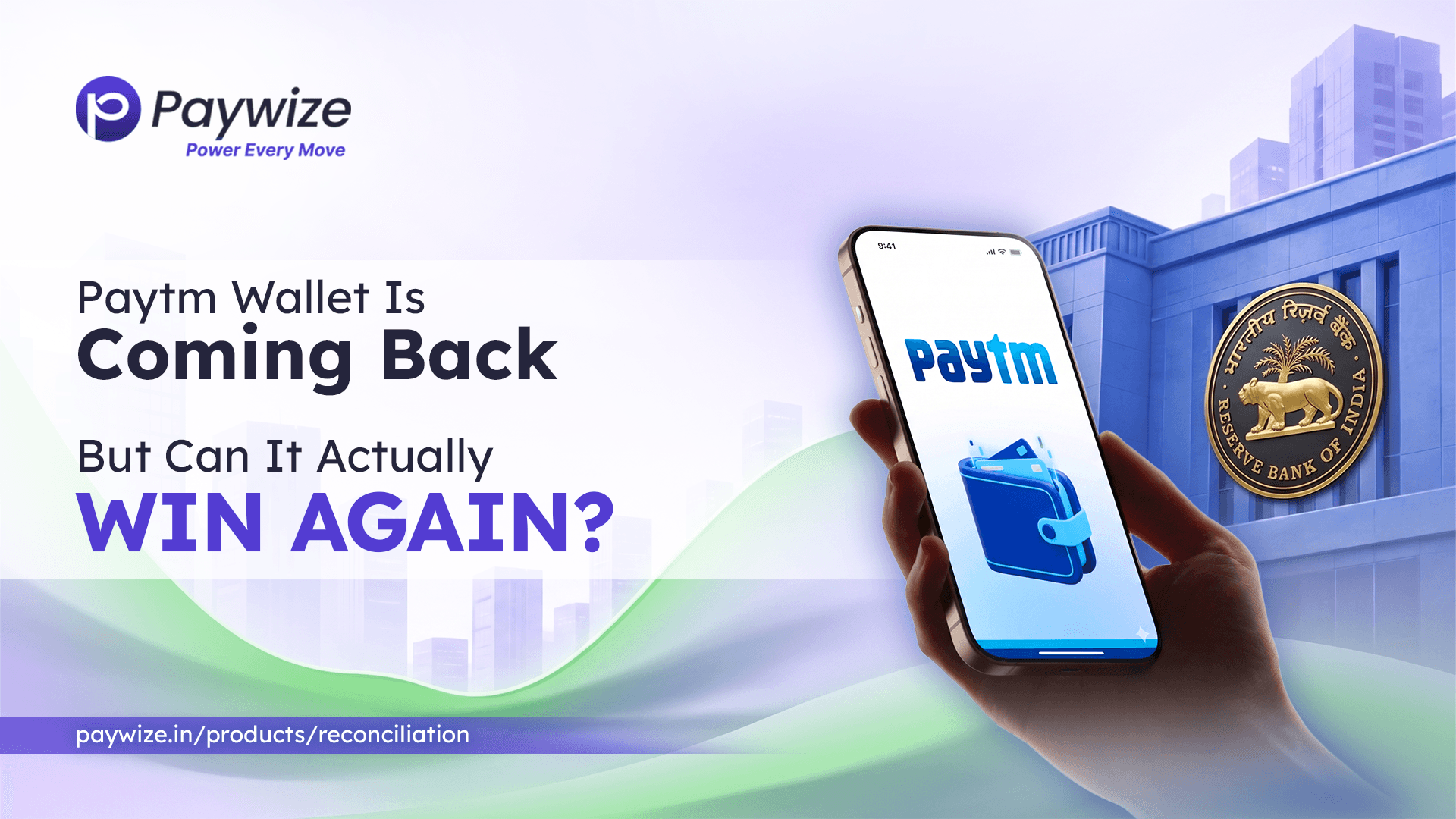
Paytm Wallet Is Coming Back - But Can It Actually Win Again?
RBI's latest approval could reopen the door for Paytm's wallet business. But with UPI now embedded in everyday payments, can the digital wallet that once helped change India's payment habits find a reason to matter again?
JJ
Jagriti Jaiswal
Head of Marketing · 17 November 2026
RBI's latest approval could reopen the door for Paytm's wallet business. But with UPI now embedded in everyday payments, can the digital wallet that once helped change India's payment habits find a reason to matter again?
There was a time when paying through a digital wallet felt like the future.
You would add money to an app, scan a QR code, and complete a purchase without reaching for your wallet. For millions of Indians, that was their introduction to cashless payments.
Paytm was at the centre of that shift. But somewhere along the way, the product that helped make digital payments familiar became less essential. UPI changed that equation.
Today, consumers can pay a neighbourhood grocery store, split a restaurant bill or transfer money directly from their bank accounts. There's usually no need to maintain a separate prepaid balance. And just as India has become comfortable with that convenience, Paytm Wallet is preparing for a possible return.
On 13 November 2026, the Reserve Bank of India granted Paytm Payments Services Limited (PPSL) in-principle authorisation to issue prepaid payment instruments (PPIs), including digital wallets.
It's an important development. But it doesn't mean the wallet has already relaunched. PPSL must still meet RBI's conditions and receive final authorisation before issuing prepaid instruments. That leaves us with a more interesting question than the headlines suggest.
Paytm may have found a way back into the wallet business. But has India already moved beyond the kind of wallet it once needed?
1. What Has RBI Actually Approved?
The recent development concerns Paytm Payments Services Limited, a wholly owned subsidiary of One 97 Communications Limited.
RBI has granted PPSL in-principle authorisation to establish and operate a payment system for prepaid payment instruments.
In simple terms, this creates a regulatory pathway for Paytm to potentially introduce a new wallet offering.
However, three things are worth keeping in mind:
This is preliminary approval, not permission to launch immediately. PPSL must fulfil the prescribed regulatory requirements.
A final authorisation is still required. The company must complete the necessary system audit and obtain RBI's Certificate of Authorisation before issuing PPIs.
The product roadmap remains unknown. Paytm has not established a confirmed public relaunch date or detailed features for the proposed wallet.
The distinction matters because preliminary approval is sometimes interpreted as an operational comeback. It isn't. It is an opportunity to prepare for one.
To understand why this development matters, we need to revisit the period when Paytm Wallet was part of everyday digital payments.
Before UPI became widespread, digital wallets offered something genuinely useful. They reduced dependence on cash and gave consumers a convenient way to make small payments. Paytm built a strong association with mobile recharges, shopping, bill payments, and merchant transactions. The wallet was familiar, accessible, and easy to understand. Then came the regulatory challenges.
In March 2022, RBI directed Paytm Payments Bank Limited (PPBL) to stop onboarding new customers.
On 31 January 2024, RBI imposed additional restrictions following persistent non-compliances and continued material supervisory concerns.
The measures affected deposits, credits and top-ups into accounts and prepaid instruments, including wallets, subject to specified exceptions.
For the existing wallet business, that was a significant disruption. Customers could no longer use the product in the same way they had previously. But an important distinction often gets lost in the discussion.
Paytm Payments Bank Limited and Paytm Payments Services Limited are separate legal entities.
The latest in-principle authorisation concerns PPSL. It does not reverse the earlier regulatory action against PPBL.
3. UPI Changed the Market While Wallets Were Losing Relevance
Here's where the comeback story becomes complicated. Paytm isn't trying to return to the same payments market it helped build. India's digital payment habits have changed considerably.
That works out to roughly 821 million transactions per day.
It's a remarkable scale.
But the more important development is behavioural. UPI has made direct bank-account payments an everyday habit. Consumers no longer have to think about loading money into a separate application before making most routine payments. A merchant displays a QR code. The customer scans it. The payment is initiated from a linked bank account.
That's it.
For an ordinary purchase, adding another funding step can feel unnecessary. And that creates a difficult question for any general-purpose wallet attempting a comeback.
What problem does it solve that UPI hasn't already made easier?
4. Paytm Wallet vs UPI: Is There Still a Meaningful Difference?
Yes. But not necessarily in the way most people think.
UPI and digital wallets aren't identical products. UPI is a payment system that enables transactions between participating accounts and eligible instruments. A prepaid wallet stores value that has already been loaded into the instrument.
The distinction becomes clearer when we compare how they work.
There's another important development.
RBI's framework allows eligible full-KYC prepaid instruments to access UPI through third-party applications, subject to applicable requirements. This means wallets don't necessarily have to compete against UPI as a separate payment network. They can potentially work within it.
Imagine you have ₹500 in your bank account. You walk into a grocery store and purchase items worth ₹300. You can pay directly through UPI. Now imagine transferring that ₹500 into a prepaid wallet first, only to make the same purchase.
Why would you do that?
For most ordinary transactions, there may be no compelling reason. And that, in my view, is the biggest challenge facing a returning wallet. The problem isn't whether Paytm can build a wallet. It's whether the product gives consumers a reason to change an established payment habit. Cashback might encourage someone to try it. A promotional offer might bring users back temporarily. But what happens when those incentives disappear?
Would the consumer continue using the wallet?
That's where the conversation needs to move beyond payment convenience.
A wallet may struggle to compete as another way to pay. It could become more relevant as a way to manage money intended for a specific purpose.
6. Where Digital Wallets Could Still Have a Future
I don't think the growth of UPI makes every prepaid wallet unnecessary. It does, however, make the case for a general-purpose wallet much harder. The stronger opportunities may lie in more specific use cases.
A. Controlled and Purpose-Based Spending
Some consumers may prefer to maintain a separate balance for particular expenses.
Think of a defined entertainment budget, a prepaid spending allowance, or money set aside for a specific purpose. A wallet can potentially provide that separation. It isn't necessarily more convenient than UPI for making a payment. But it may be useful for managing how a particular amount is spent.
B. Employee Benefits and Business-Funded Programmes
Businesses sometimes need ways to distribute defined amounts for eligible benefits, incentives, or reward programmes. Depending on the product structure and regulatory permissions, prepaid instruments may support such arrangements. The value here isn't simply digital payment acceptance. It's the ability to structure a particular spending experience.
C. Prepaid Instruments Within the UPI Ecosystem
This may be the most interesting possibility.
If an eligible prepaid instrument can work through UPI, users may not need to adopt an entirely separate payment experience. The wallet becomes a funding option rather than a competing payment habit. That could make certain prepaid use cases easier to integrate into how consumers already pay. Of course, these are broader industry possibilities. They should not be interpreted as confirmed features of Paytm's future wallet.
7. Paytm's Biggest Competitor May Be Consumer Habit
It's tempting to frame the comeback as Paytm versus other fintech companies. But the bigger challenge may be behavioural. Consumers already have applications they use regularly. They know how to scan a QR code, enter a UPI PIN, and complete a payment. They don't necessarily feel that something is missing.
So any new wallet offering will need to answer a few difficult questions:
Why should consumers fund a wallet instead of paying directly from their bank accounts?
What would encourage repeat usage beyond discounts and cashback?
Which payment experiences genuinely benefit from a separate prepaid balance?
Can the wallet become commercially sustainable without relying heavily on incentives?
These aren't questions that regulatory approval alone can resolve.
They require product-market fit. And product-market fit in today's digital payments ecosystem looks very different from what it did a decade ago.
8. What Does Paytm Wallet's Comeback Mean for Indian Merchants?
This is the part of the story I find particularly interesting. For consumers, payment innovation is often about convenience. For merchants, convenience is only one part of the equation. A growing business may already receive payments through UPI and other supported methods. Adding another payment option could help serve a particular customer segment. But it can also introduce operational considerations. Consider what happens after a payment is completed.
The merchant still needs to understand:
Was the transaction successful?
Which customer or order does it belong to?
Has the payment been recorded correctly?
How will it appear in settlement records?
Can the finance team reconcile it without unnecessary manual intervention?
These questions become increasingly important as transaction volumes grow.
A business handling hundreds of payments may manage certain exceptions manually.
A business handling thousands or millions of transactions needs more structured workflows.
Accepting a payment and managing a payment operation are not the same thing.
And that distinction is becoming more relevant as India's digital payments ecosystem expands.
9. The Paywize Perspective: India's Next Payment Challenge Isn't Just Acceptance
At Paywize, our work with payment and banking technology reinforces a broader industry observation. Businesses don't necessarily struggle only because they lack ways to accept payments. They can also face challenges in managing the processes surrounding those payments.
Transaction visibility, reconciliation, payment status, and the connection between banking workflows and business systems can all affect operational efficiency. That's why I believe the next phase of fintech innovation will be shaped as much by the infrastructure behind payments as by the payment methods consumers see.
Paywize operates as an API-first Technology Service Provider (TSP), offering technology solutions across Collections, Payouts, and Connected Banking through integrations supported by licensed banking and payment partners.
We do not issue prepaid wallets, provide payment aggregation services or hold customer funds. Our focus is on helping businesses connect payment-related workflows through technology. And that's where the potential return of wallets becomes relevant to the broader merchant ecosystem. A new payment method can increase choice.
But that choice becomes valuable to a business only when it serves a real customer need and fits into manageable operational processes. The future isn't necessarily about adding every possible payment option.
It's about making the payment journey work better from beginning to end.
10. Can Paytm Wallet Actually Win Again?
I think it has an opportunity.
But success may not look like it did in the wallet's earlier years.
Paytm has considerable brand familiarity and experience in India's digital payments ecosystem.
That gives it a starting point. What it doesn't guarantee is consumer demand for a familiar product in a changed market. A future wallet could find relevance in specialised prepaid spending, benefits, or other integrated payment experiences. It could also struggle if its primary proposition is simply another balance to maintain.
The deciding factor will be whether the product offers a clear benefit that consumers and businesses cannot obtain as conveniently through existing alternatives. So perhaps the wrong question is whether Paytm Wallet can become as popular as it once was.
The better question is whether it can become useful in a different way.
The Bigger Picture: India's Fintech Industry Has Moved On
India's first wave of digital payment innovation was largely about making cashless payments accessible. UPI then helped make digital transactions familiar, interoperable, and widely adopted. The next stage will require a different kind of thinking. Consumers may expect more specialised financial experiences. Merchants will continue looking for better payment visibility and operational efficiency. And technology providers will need to build systems that work across an increasingly interconnected ecosystem. There's room for innovation beyond UPI. But simply recreating older payment experiences may not be enough. Paytm's potential wallet revival is an interesting test of that reality. It may succeed by finding a new role for prepaid payments. Or it may demonstrate just how hard it is to change consumer habits once a simpler alternative becomes the norm.
Either way, the development is worth watching.
Paytm Wallet may be coming back. Whether India comes back to the wallet is a different question altogether.
Frequently Asked Questions
Is Paytm Wallet coming back in 2026?
Paytm Payments Services Limited received in-principle RBI authorisation on 13 November 2026 to issue prepaid payment instruments, including digital wallets. A commercial relaunch remains subject to final regulatory authorisation.
Has RBI fully approved the Paytm Wallet relaunch?
No. The authorisation is preliminary. PPSL must complete the prescribed regulatory requirements and obtain final RBI approval before issuing prepaid instruments.
Why did Paytm Wallet face restrictions?
The earlier wallet business was affected by RBI restrictions imposed on Paytm Payments Bank in 2024 following regulatory and supervisory concerns. These measures affected wallet top-ups and other specified activities.
Is Paytm Wallet better than UPI?
Neither is universally better. Bank-account-linked UPI is convenient for everyday payments, while prepaid wallets may offer value in specialised spending and business-funded use cases.
Can digital wallets work with UPI?
Yes. Eligible full-KYC prepaid instruments can support UPI interoperability under RBI's regulatory framework.
Will Paytm Wallet replace UPI?
There is no indication that it will. Wallets may instead find opportunities in use cases that complement UPI rather than replace it.
What does Paytm Wallet's potential comeback mean for merchants?
A future wallet offering could introduce additional payment choices. Merchants should assess customer demand, payment integration, transaction visibility, reconciliation and applicable commercial terms before adopting new instruments.
For More Information & Enquiries
For industry research discussions, media enquiries, business collaborations, or information about Paywize's technology solutions, please connect with:
Jagriti Jaiswal Head of Marketing marketing@paywize.in Paywize Technologies Private Limited
Editorial note: This article reflects publicly available information and industry analysis as of 17 November 2026. Any discussion of potential future wallet features is analytical and does not represent a confirmed Paytm product announcement. Paywize operates as a Technology Service Provider, with regulated payment and banking services provided through licensed partners.
Share:
READY TO GET STARTED?
Join 1,200+ merchants using Paywize to power their payment infrastructure.